
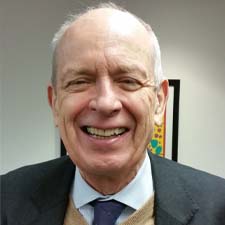
Pete Eikenberry
A couple of years after my wife Sue and I arrived in New York City in 1964, we found a brownstone to buy for $23,000 in Fort Greene, across from Fort Greene Park. Since Bankers Trust was a client of my employer White & Case, I was able to get a $12,000 purchase money mortgage from it in a red-lined area, the seller took back an $8,000 second mortgage, and my father-in law loaned me $3,000. (Starting salary at White & Case in January 1964 was $7,800.)
Thereafter, Spike Lee’s mother Jackie, a beloved St. Ann’s teacher of our daughter Kris, called Sue for help in finding a house in Fort Greene for the Lee family. Sue walked her around the neighborhood, and the Lees bought a house, also across from the park, on our street. Thus, the Lees came to live on the same street as the Eikenberrys. Spike’s father, Bill, frequently gave two of my kids, Doug and Kris, rides to school in his Citroën station wagon.
I got season tickets for the New York Knicks around 1967 courtesy of a helpful printer for the White & Case corporate department. My 10-year-old son, David, and Spike, age 12, were both Knicks fans, and I gave them tickets more than once in 1970. One night, Spike and David did not come back from a game till quite late. They had been waiting outside of the entrance of a bar to get a player’s autograph.
The Knicks
In June 1970, the Knicks were playing the Los Angeles Lakers in the National Basketball Association finals. Game 7 was at Madison Square Garden. At the time, I was a reform Democratic candidate for Congress against Republican John Rooney, a powerful congressman who supported the Vietnam War. (I lost the election by 1,100 votes – thankfully, because I lead such a much better life than does a congressman, but Time magazine reported that Rooney changed his vote on the war because of the threat of my campaign.) My campaign staff would not permit me to go to Game 7, so I handed the tickets to my wife, Sue, and said, “Go to the game and get a ticket to Spike.”
(Spike remembers this a little bit differently. In an article he wrote recently for the New York Times, available at https://www.nytimes.com/2026/06/03/opinion/new-york-knicks-nba-championship.html?searchResultPosition=1, Spike wrote, “My father’s lawyer, Peter Eikenberry, had season tickets to the Knicks, and invited me to join him for Game 7. My father had a concert that night. My mother, Jackie, said, ‘You really should go to the concert,’ but my father said, ‘Naw, Spike’s going to the game.’ So I went.”)
Bill Lee
I had been a pro bono lawyer to Spike Lee’s father, Bill Lee. He was a composer and the leader of his own jazz group. (In 2024, Wynton Marsalis performed a composition of Bill’s during a lecture with music as the Second Circuit Thurgood Marshall lecturer.) Every night Bill parked his Citroën station wagon in front of his house on our street in Fort Greene. Every morning, the 87th Precinct ticket guy gave him two moving violations as he started up, one for Virginia license plates and one for his Virginia driver’s license. He called me to ask me to go to traffic court with him for his dozens of moving violations. It was in a remote part of central Brooklyn. As I stood up, the judge said, “Mr. Eikenberry, do you want mercy or justice?” I said, “Mercy, Your Honor, Mercy!” We did well that day! I then took Bill to the precinct, and I introduced him to the captain as a musician with residency in more than one state. In 2023, I learned at Bill’s memorial service that the police in the precinct had been instructed to never again give a ticket to Bill. They did not for the rest of his life, a major achievement of my legal career!
Gage & Tollner
When Sue and I were first in Brooklyn, a real treat was to go to dinner at the Gage & Tollner restaurant. There, the maître d’ and all the waiters were Black men. The lighting was supplemented by candles above the large mirrors lining the inside walls of the restaurant. One of the nine or ten waiters, Jim Strawder, became a close friend of ours. He had discovered a vacant old bank building in Dumbo, where he wished to establish his own restaurant. I represented him in negotiating a 35-year lease.
Two Brooklyn businessmen loaned him $15,000 each and his wife had saved $5,000; he had saved $15,000, as the result of winning a chess game with a friend and then taking the few bucks he won at chess and placing them on a number, which “came in.” Jim got a Small Business Administration loan and remodeled the building. Jim’s son was his architect and my son David was a summer employee on the renovation. Jim then opened Ferrybank, which quickly became Brooklyn’s premier white tablecloth restaurant. Black people of stature from out of town as well as men from the Brooklyn business community went there on special and other occasions.
One day, years later, as I came out the door of my home to go to work, Spike was directing a scene for his first movie, “She’s Got to Have It,” at an upper floor of our home. He said to me, “I’ve got my own Knicks tickets now – in the blue.” The blue section was higher than my seats “in the yellow.” Spike then filmed the rest of his first movie in the unused upper floors of Ferrybank.
As reported in the book Gods of New York by Jonathan Mahler:
Lee edited the film on a rented machine wedged between the bed and the large collection of jazz records in his studio apartment in Fort Greene. She’s Gotta Have It was a quirky romantic comedy, but also, in its way, revolutionary. At a time when Hollywood was still sprinkling people of color judiciously into films, typecasting them as singers, dancers, or comedians, the film’s all-Black cast included an investment banker, a male-model- turned-photographer, and a bike messenger (Lee’s Mars Blackmon character). It was screened at Cannes, where Lee won the Prix de la Jeunesse in 1986.
Spike Lee has done much to put Brooklyn on the cultural map. His offices are still located in Fort Greene, and there was recently a Spike Lee Exhibit at the Brooklyn Museum. Jim Strawder’s efforts as another Black man supported Spike Lee’s career at a crucial moment. Spike is a legendary and inspiring leader of the Black community, and Jim Strawder was in his day another one.